
November 13, 2026, Durham, NC – In our previous three blogs in this mindfulness series, we explored the benefits of mindfulness and how mindfulness education should evolve alongside students’ cognitive, emotional, and social development. While mindfulness may seem too abstract for children to understand or put into practice, elementary school students are capable of learning and practicing mindfulness skills. In fact, these early years are an optimal time to introduce mindfulness so that students can continue developing and adapting their skills as they grow.
In this blog, we explore examples of mindfulness skills that elementary school students can learn, how to make instruction developmentally appropriate, and how schools can incorporate mindfulness education into their daily routines.
Mindfulness Skills That Elementary School Students Can Learn
In elementary school, children can learn mindfulness skills. For example, they can learn to:
- Become more aware of their breathing and body movements
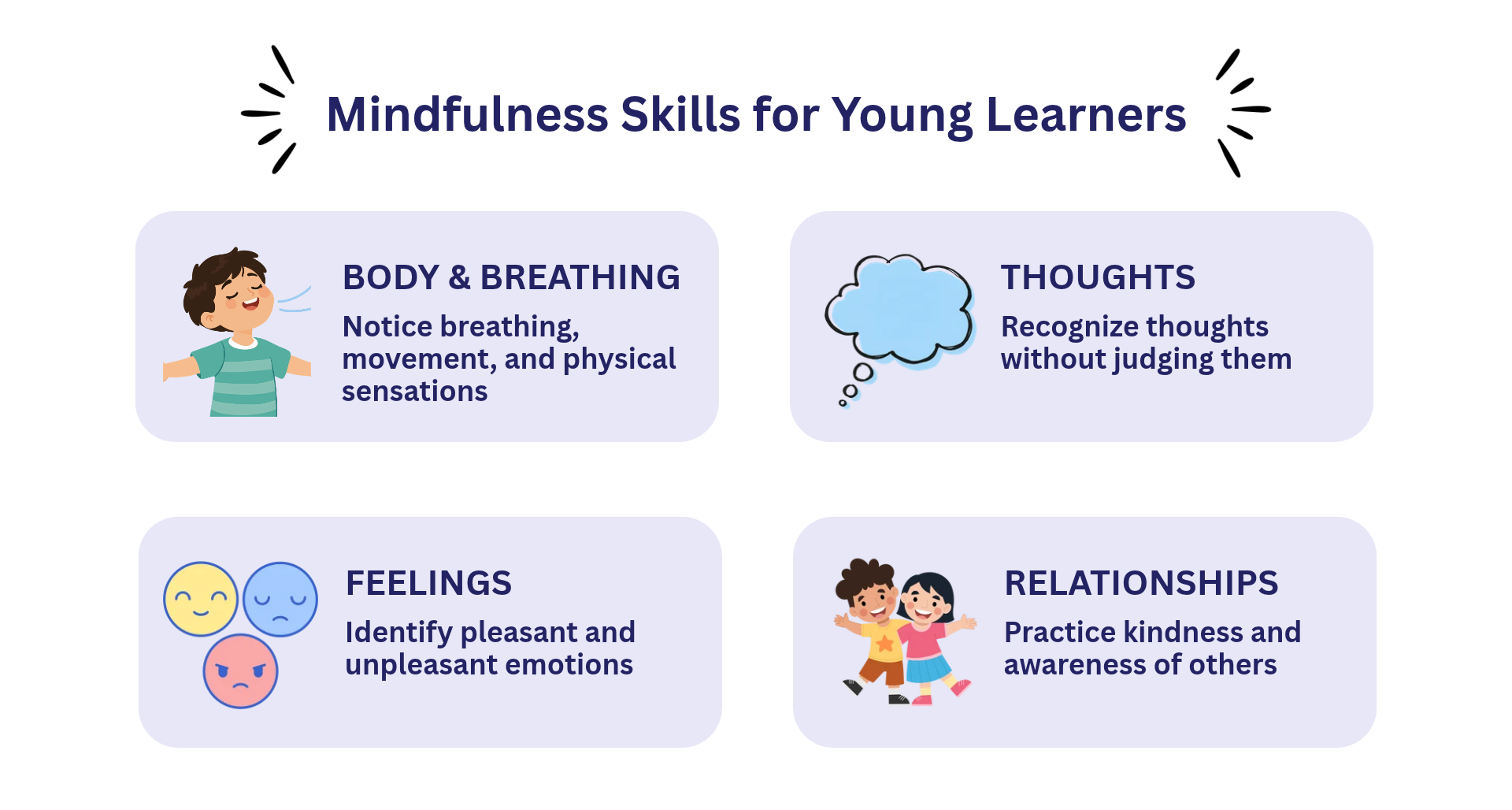
Mindfulness education can teach children how to pay attention to their breathing, explore their five senses, and notice how their bodies move (e.g., mindful movements). This awareness can help them feel more present and grounded to cope with difficult emotions or situations.
- Become aware of their pleasant and unpleasant feelings
Most children are able to learn to identify different emotions and practice recognizing how they feel. Developing awareness of and recognizing pleasant and unpleasant emotions are important steps children can take before they learn to manage their emotions instead of ruminating or sitting in discomfort.
- Notice thoughts about themselves and others
Children can learn how to recognize their thoughts and accept their thoughts without judgment. They can also explore the idea that thoughts are not facts and that not everything they think is necessarily true.
- Think about their relationships with themselves and others
Children can build self-esteem and confidence by exploring how to have compassion for themselves. Becoming aware of their relationships with others can also help them to be aware of how their actions or words might impact others.
How Can Mindfulness Practices Be Made Developmentally Appropriate for Elementary School Students?
To effectively teach mindfulness skills to elementary school students, instruction must account for their developmental abilities. For example, children generally have shorter attention spans than adults, so mindfulness lessons and activities should be brief, engaging, and easy to follow.
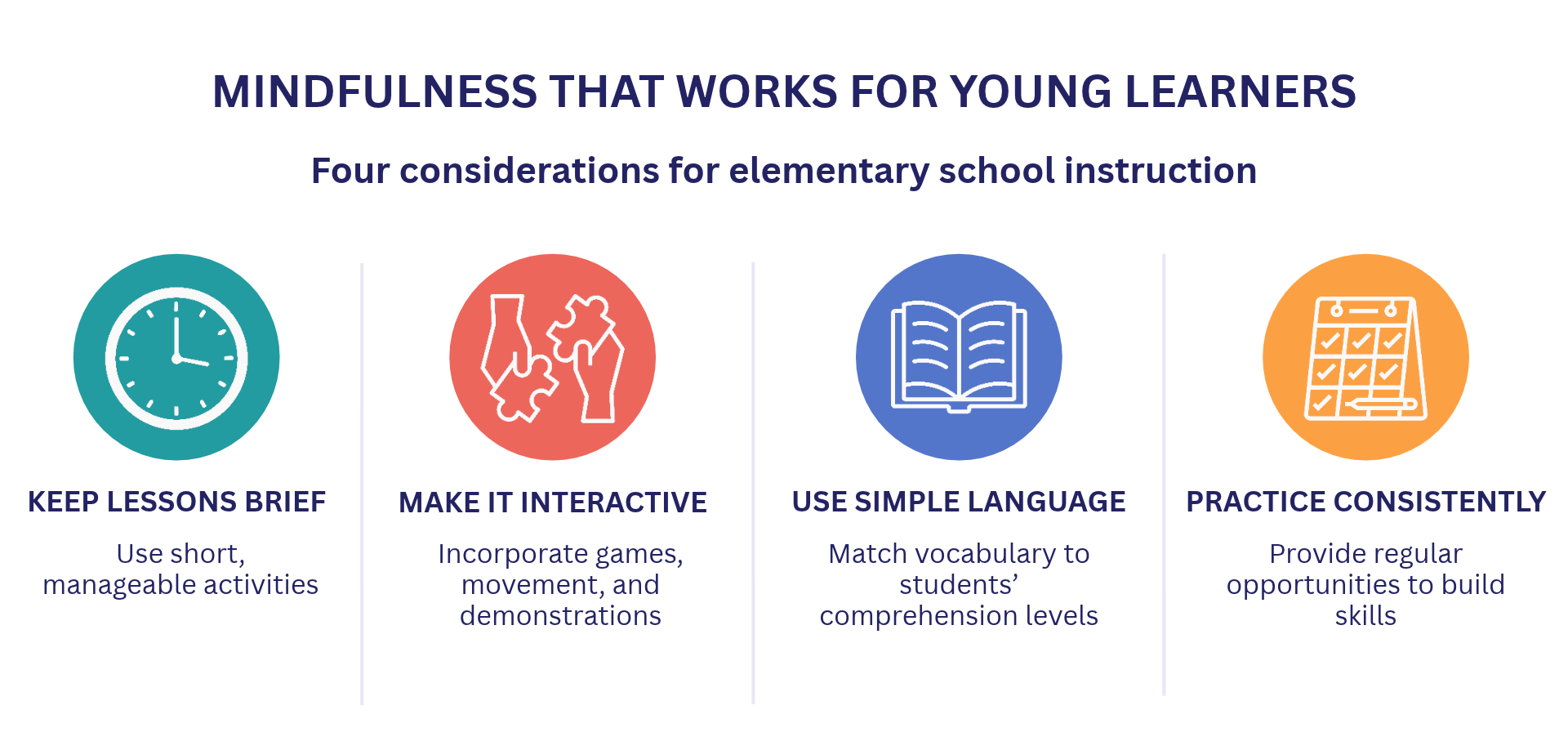
While elementary school students can learn to become aware of their bodies, feelings, thoughts, and relationships, some mindfulness concepts may be too abstract or complex for this age group to understand and apply. Mindfulness curricula and activities should be carefully designed to match their cognitive and emotional abilities, and vocabulary used must match the reading and comprehension level of learners.
Elementary school students do not learn best through lecture or reading alone. Mindfulness education for this age group should include interactive activities, demonstrations, and videos to make mindfulness concepts more concrete and help students practice what they learn.
Can Mindfulness Skills Be Taught in Elementary School Settings? How?
Yes, mindfulness skills can be taught in the classroom. Short, daily mindfulness lessons are a practical way to integrate mindfulness learning into everyday classroom schedules. By beginning a lesson or school day with a brief mindfulness lesson or activity, instructors can help students settle and prepare their minds for learning. Brief daily lessons delivered consistently over time may better support children in thinking about and using mindfulness in everyday situations, even when they are not in the classroom.
Schools are also well-positioned to deliver effective mindfulness education to students. Instructor-led programs allow teachers or other school staff to lead mindfulness lessons, model and demonstrate mindfulness practices, and answer student questions as they arise, reinforcing student learning.
What Mindfulness Education Program Should You Choose for Elementary School Students?

Master Mind is a research-informed mindfulness education program designed to help elementary school students develop healthy coping strategies, regulate their emotions, and improve their attention and executive functioning. By teaching healthy ways to cope with stress, this mindfulness program also aims to prevent substance use as an unhealthy coping strategy.
Through Master Mind, 4th and 5th grade students explore:
- Breathing and body movements
- Pleasant and unpleasant feelings
- Thoughts about themselves and others
- Relationships with themselves and others
The program is developmentally appropriate and engaging for 4th and 5th grade students and was developed with feedback from 4th and 5th grade teachers and students to ensure that it meets student and school needs.
Master Mind is also designed to be easily implemented in elementary school classrooms. The program includes multimedia instructional materials, a Teacher Manual, Student Workbooks, and a web-based teacher training and certification. Teachers do not have to rearrange entire lesson plans and schedules for long mindfulness workshops. With Master Mind, instructors can spend just 15 minutes a day over five weeks leading brief lessons that help students develop and practice mindfulness skills.
Ready to start using Master Mind at your school? Visit https://mastermindprogramsonline.com/ to learn more and get started.
 English
 Español